

Project Overview
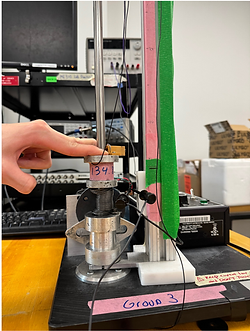
This project focused on designing and characterizing a weakly nonlinear spring-mass oscillator using a linear potentiometer as a displacement sensor. A custom data acquisition and analysis workflow was developed to measure system dynamics, including natural frequency, damping ratio, resonance behavior, phase lag, and magnitude response through both step and sinusoidal inputs.
Skills and Tools:
MATLAB.
Data Acquisition.
Sensor Calibration.
Signal Processing.
FFT Analysis.
Experimental Testing.
Uncertainty Analysis.
Dynamic Systems.


Features and Specifications:
Total Mass: 9.805 g (under 10 g competition threshold)
Volume: 150 cm³ (82.5 × 56.07 × 40.5 mm envelope)
Propulsion: Coaxial counter-rotating rotors, 2× 6mm brushed DC motors
Control: 6-axis IMU (BMI323), ATSAMD21 microcontroller, PID stabilization
Power: 3.7V / 70mAh LiPo or tethered 6V / 1A external supply
Payload Capacity: 2.1 g (exceeded 2 g target)
Flight Duration: Theoretically unlimited (tethered); 10+ min demonstrated
PCB: Custom 4-layer FR4, 35 × 35 mm, fabricated by JLCPCB
Yaw Control: Differential rotor torque via MOSFET PWM
Assembly Time: Under 1 day
Contents
Mar 2025
Apr 2025
Boston University
Instrumentation

Problem and Task
Mechanical systems are often subjected to vibrations that can significantly affect performance, reliability, and safety. Understanding how system properties such as stiffness, damping, and natural frequency influence dynamic behavior is essential when designing engineering systems. The objective of this project was to experimentally characterize a spring-mass-damper system and develop methods for accurately measuring displacement, identifying system parameters, and validating theoretical dynamic models using real-world data.
My Tasks:
Assisted in the experimental setup and testing used to determine the spring constant.
Calibrated the linear potentiometer to convert voltage measurements into displacement data.
Collected and processed raw experimental data from the DAQ system.
Helped develop MATLAB scripts for Fast Fourier Transform (FFT) frequency analysis.
Performed uncertainty analysis and error propagation calculations for key system parameters.
Constraints
Limited to the provided spring-mass system and laboratory instrumentation.
Required accurate displacement measurements using a calibrated linear potentiometer.
Sensor noise and friction effects had to be minimized through signal processing techniques.
Dynamic response had to be characterized using non-destructive testing methods.
Experimental results needed to be validated through uncertainty and error analysis.
Engineering Solutions
Mechanical

Electrical

Sensor Integration
Integrated a linear potentiometer for displacement measurement.
Connected sensor outputs to the DAQ acquisition system.
Verified sensor performance through calibration testing.
Converted voltage signals into displacement measurements.
Supported data collection during dynamic testing.
Data Acquisition
Utilized a National Instruments PCI-6221 DAQ board.
Recorded displacement data during step and sinusoidal inputs.
Exported experimental datasets for MATLAB analysis.
Captured high-resolution voltage measurements.
Enabled repeatable testing procedures.
Software
MATLAB Processing
Processed experimental displacement data.
Applied FFT analysis to identify dominant frequencies.
Filtered noisy sensor data for improved accuracy.
Analyzed system response characteristics.
Generated data used for dynamic system evaluation.

Testing
Conducted spring extension testing to experimentally determine the spring constant.
Performed linear potentiometer calibration using measured displacement and voltage data.
Recorded step response data to evaluate damping characteristics and system behavior.
Collected sinusoidal response data across multiple excitation frequencies to identify resonance.
Validated experimental results through uncertainty analysis and comparison with theoretical models.

Results
Developed a calibrated displacement measurement system using a linear potentiometer and DAQ.
Successfully characterized the spring-mass-damper system’s stiffness, damping, and frequency response.
Identified the system’s resonance frequency and dynamic behavior through FFT analysis.
Quantified uncertainty for experimentally derived parameters and validated measurement accuracy.
Demonstrated strong agreement between theoretical predictions and experimental results.

Determined a spring constant of approximately 77.4 N/m through experimental testing.
Measured a natural frequency of approximately 22.6 rad/s using dynamic response data.
Calculated a damping ratio of approximately 0.188 through envelope decay analysis.
Identified system resonance at approximately 23.6 rad/s.
Lessons Learned
Developed a stronger understanding of second-order dynamic systems.
Learned how sensor calibration impacts measurement accuracy.
Gained experience applying FFT techniques to experimental data.
Improved proficiency in uncertainty propagation and error analysis.
Strengthened skills in experimental testing and data interpretation.


